Free Daily Feelings Check-In Worksheet for Kids | SEL Printable Ages 7–12
Download this free Daily Feelings Check-In worksheet for kids aged 7–12. Help children name their emotions, understand why they feel that way, and discover

4th October 2026
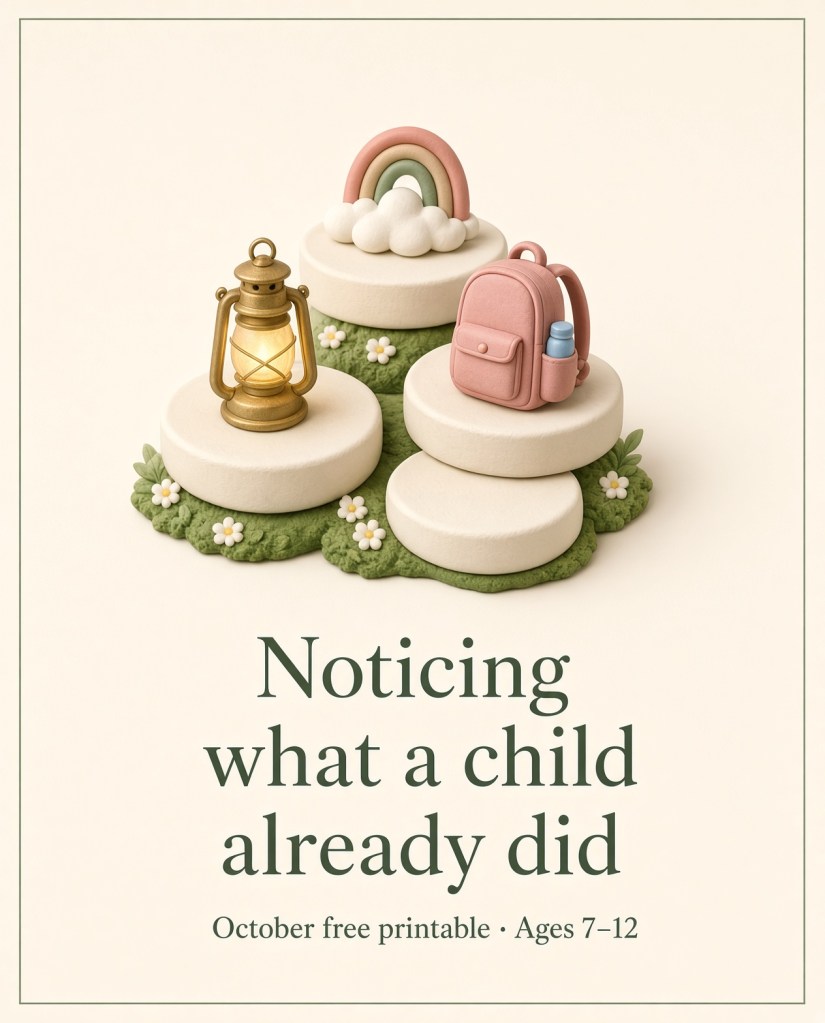
October’s free printable is Sheet 1 of the Noticing Stickers: fifteen small rounds for a school day. A lantern, a backpack, a compass, a path up a hill. Under each one, a short line in the past tense. You found a way. You got ready. You chose. You kept going. You looked after yourself. You used your voice. You completed something that mattered.
They are not house points. Nothing is earned, and nothing is withheld until a child complies. The sticker names something that already happened. The child decides whether to take it, put it somewhere, or leave it.
That matters on ordinary mornings, and it matters more on the mornings that do not run smoothly.
Some children find the start of a day heavier than the day itself. Getting a bag ready, choosing what to wear, moving from the kitchen to the door, then from the playground into the classroom. Each step is a whole job. A sticker that says you got ready does not ask them to do it faster next time. It marks that they did it.
Some children feel a change before anyone else has noticed it. A different seat. A supply teacher. A noise that will not settle. They may go quiet, or they may not. A hard moment is still a hard moment if they got through it without a story. The rainbow sticker is for that. No one has to explain what the moment was.
Some children know what they want to say and cannot get it out in the time the room allows. Some say no, and then worry they have done the wrong thing. You used your voice is not a prize for speaking up in front of the class. It can be a quiet no, a question, or one true sentence to one person.
At home, four stickers on the table are enough. Forty-five is a catalogue. After school, name what you saw — you kept going with the reading, you looked after yourself when it got loud — and offer the matching round if they want it. Let them pick a different one. Let them take none. None is a complete answer. If they have a book or a pencil case, they choose where it lives. It does not go on the fridge as proof.
In a classroom, the same rule holds. Offer a few at a time, not the whole sheet. A calm-corner dish works better than a wall chart the whole class can read. A private notebook is safer than a display. Do not collect the stickers back in. Do not use them to make a child apologise, sit still, or “earn” the next part of the day. If a child disagrees with what you noticed, believe them. The sticker belongs to their story, not yours.
Mixed feelings are allowed. A child can have got ready and still have hated it. They can have been brave and still be tired. The line does not tidy that up.
Sheet 1 is the school day. The Etsy shop holds the rest of the same language, if you want it. Sheet 2 is help, rest, repair and boundaries: asking for help, taking a break, coming back after a wobble, saying no kindly. Sheet 3 is honesty, belonging and staying: waiting, telling the truth, sitting with someone, forgiving yourself. The Noticing Cards are the same forty-five drawings as larger cards, for a table or a session bag, when a peel-off sticker feels too much like a prize. My Noticing Book is a thin book the child keeps. Some pages have a circle for a sticker. Some are empty on purpose. The last page is for the adult. The rest belongs to the child. You can use one piece on its own. Nothing in the set requires the rest.
Sheet 1 is free this month at gentlepathtoolkits.com. Print it at actual size. The shop packs are there when you want the rest.
One sticker. One true thing. Theirs to take, keep, or leave.
Download this free Daily Feelings Check-In worksheet for kids aged 7–12. Help children name their emotions, understand why they feel that way, and discover